
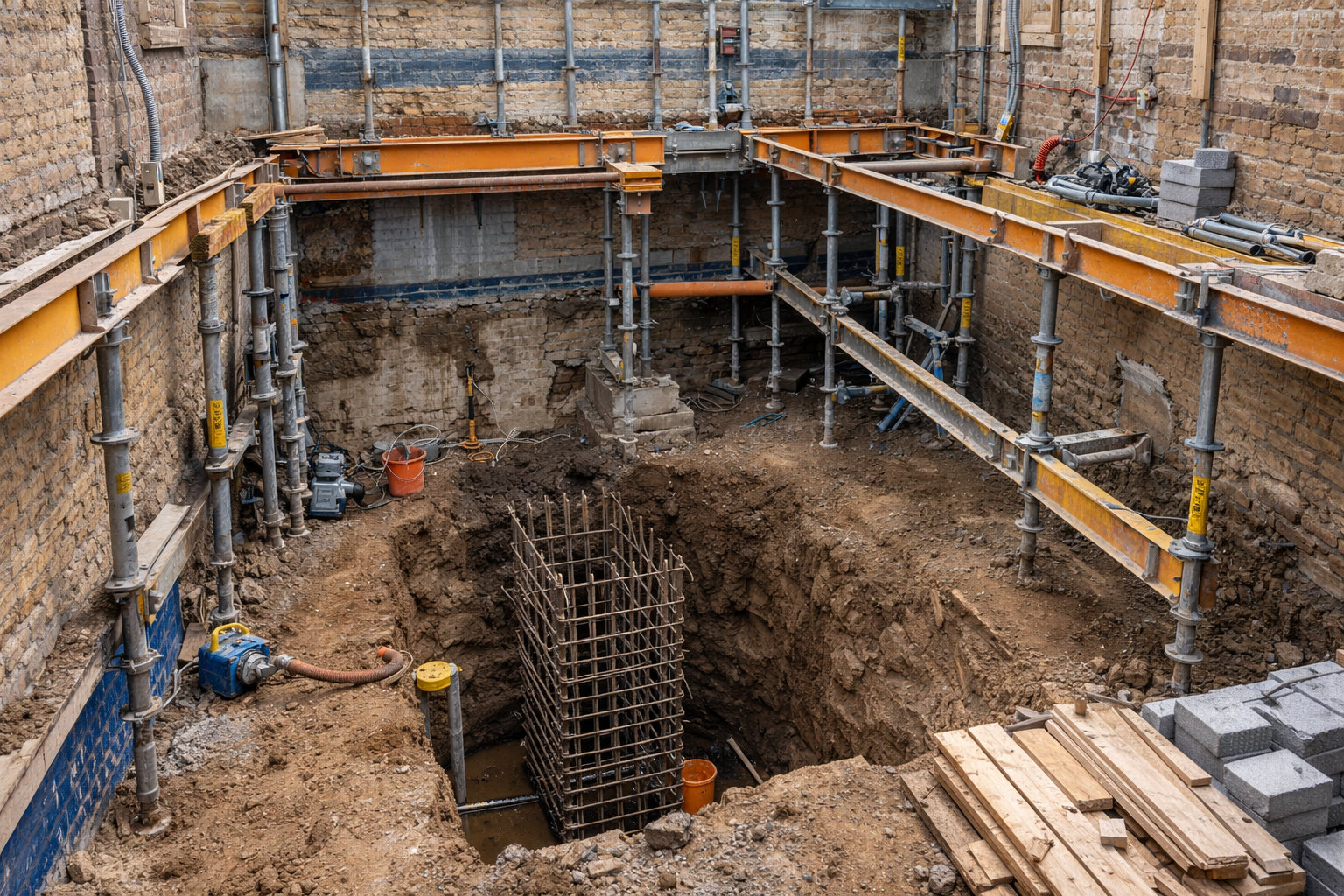
This case study shows how the Party Wall etc. Act 1996 can be applied to a basement excavation project involving neighbouring property, structural risk and excavation close to adjoining foundations. It demonstrates how early surveyor involvement and clear documentation help reduce risk and support a controlled construction process.
Bloomsbury Surveyors advises building owners, adjoining owners, developers and project teams across Brighton, Hove and Sussex on party wall matters involving basement excavation and other structurally sensitive works.
Project Overview
This project involved the excavation of a new basement level beneath an existing property. The proposed works included deep excavation close to adjoining structures and temporary support measures that required careful review under the Party Wall etc. Act 1996.
Because of the potential effect on neighbouring foundations and the structural sensitivity of the site, party wall procedures were required before work could begin.
The Initial Situation
The building owner intended to create additional accommodation by excavating below the existing building footprint. The project team had prepared design information and structural proposals, but the neighbouring owner raised concerns about movement, cracking and the possible impact of the excavation on their property.
Given the nature of basement excavation, these concerns were reasonable and needed to be addressed through the formal party wall process.
Notice and Surveyor Appointment
The relevant notices were served on the adjoining owner explaining the proposed excavation works and structural implications. The adjoining owner chose to dissent, which triggered the appointment of surveyors under the Act.
The surveyors then reviewed the proposals and began the process of assessing risk, inspecting the neighbouring property and preparing the required documentation.
You can read more on our Party Wall Notice Guide page.
Assessment of Structural Risk
Basement projects often require closer review than standard domestic works because excavation can affect ground stability, adjoining foundations and structural behaviour during the build. The surveyors therefore reviewed the engineering proposals and considered the likely impact on neighbouring property.
Particular attention was given to:
- The depth and location of excavation
- The proximity of neighbouring foundations
- Temporary support and sequencing of works
- The potential for vibration, cracking or movement
- Protective measures during construction
Schedule of Condition
A detailed schedule of condition was prepared for the adjoining property before works began. This included written observations and photographs of visible cracking, finishes and structural elements in areas most likely to be affected.
This record was especially important because the adjoining building already contained some historic cracking. The schedule helped distinguish pre-existing condition from any later change.
The Party Wall Award
Following review of the technical information and discussion between the surveyors, a Party Wall Award was prepared. The award set out the basis on which the basement works could proceed and the protections required for the neighbouring property.
The award included:
- Description of the proposed basement excavation works
- Reference to drawings and engineering information
- Schedule of condition of the adjoining property
- Protective measures and working requirements
- Access provisions where necessary
- Procedures for addressing damage if it arose
Further guidance is available on our Party Wall Award Explained page.
Construction Phase
Once the award had been served, the project proceeded in accordance with its terms. Because the process had been handled thoroughly in advance, there was a clear framework for managing neighbour concerns during the construction phase.
The existence of a proper award and schedule of condition helped maintain clarity and reduced the likelihood of unnecessary escalation during the works.
Outcome
The basement excavation progressed with the necessary protections in place. Minor issues raised during the project were dealt with through the agreed surveyor process and did not develop into wider dispute.
The case showed the importance of taking basement excavation seriously from a party wall perspective and dealing with structural risk early rather than reactively.
Key Lessons From This Case
This case study highlights several important lessons:
- Basement excavation is one of the most structurally sensitive types of party wall work
- Neighbour concerns should be addressed early and professionally
- Schedules of condition are especially important where older properties are involved
- Clear technical review supports smoother project delivery
- Well prepared awards help reduce uncertainty during construction
How Bloomsbury Surveyors Can Help
Bloomsbury Surveyors advises on basement excavation party wall matters across Brighton, Hove and Sussex. We assist with notices, awards, schedules of condition and dispute resolution for both residential and commercial projects.
Our approach is practical, professional and focused on reducing risk before works begin.
Related Party Wall Pages
- Party Wall Basement Excavation
- Party Wall Notice Guide
- Party Wall Awards Brighton
- Party Wall Dispute Resolution Brighton
- Party Wall Case Study Commercial Development
- Party Wall Damage Claims
- Party Wall FAQs
Frequently Asked Questions
Does basement excavation usually require party wall procedures?
In many cases, yes, because excavation often takes place close to adjoining structures and foundations.
Why are basement projects more sensitive than other works?
Because they can affect ground stability, neighbouring foundations and structural movement during excavation.
What is the benefit of a schedule of condition on basement works?
It provides a record of the adjoining property’s condition before work begins, helping assess any later damage concerns fairly.
Do you advise on basement excavation party wall matters in Brighton?
Yes. We assist clients throughout Brighton, Hove and Sussex.